Category: Background Braps

  • Odyssey, Pt. 5

    ctrl-alt-delete

    2001 would be a big year for history and something like a reset for me. There would be a change of tempo, and stability at last, but all that was ahead of me.

    I had arrived in Southampton just under four years prior. I had been through eight job moves and six home address changes in that time, three of which were in the last year.

    I had an ace up my sleeve in the form of my job. They enabled me to return to full time hours seamlessly. Thus, in the pit of despair about the failure of my university ambitions, I could simply go back to work on Monday, as if nothing had happened. This might not have been the most healthy approach, but like pulling out a tooth, it would be effective.

    No postmortem was needed at this point, it wouldn’t have helped me and would have changed nothing. My eyes were fixed forward.

    I was sharing my girlfriend’s flat in Cranbury Place. The gravity well of SO14’s Bevois Valley had pulled me back in, as it would in future. The address was the other side of the Royal South Hants from Graham Rd, the place of my early Withnalian existence (there’s a blue plaque), and about five minutes on foot from Middle street, the last address I shared with the lads (and Harriet). The flat was alright, and no longer on fire. It would do. The neighbourhood wasn’t great, the street apparently having a number of halfway houses. Shouting matches in the small hours were common, as were police vans.

    I had my first overseas holiday in seven years that March. A week in off-season Cyprus, a dirt cheap package deal. It was a welcome change of scene and I could have done with more time.

    Summer passed by, life rapidly came back to normal. The question of returning to University loomed, as I had to make a decision. I decided against re-entry. That door was closed and I did not want to open all that up again. it was mentally in a steel box, under permafrost. Besides, I had not looked at a maths text since I’d left.

    I returned from lunch one September afternoon. It was about 1pm, and the buzz in the office was a plane had apparently struck New York’s World Trade Center. “What fucking plane? Don’t be daft”. It was hard to find a news page that would actually load, but the BBC showed the famous image of WTC 1 ablaze with thick black smoke against a perfect azure sky.

    In the Walkabout pub (now long gone) after work with my colleague oxbridge Rob, a news channel looped UA175 repeatedly slotting into WTC2 like some absurdly overblown disaster film. “Turn it off, I can’t watch it anymore” barked the Australian girl that managed the bar.

    BT, in yet another example of spectacularly awful leadership, had overextended itself financially in gobbling up 3G wireless licenses. Consequently the telco giant would have to sell off its mobile business, Hence, o2 was born. Oh, and also, you’re all getting fired. It’s a gas gas gas.

    A colleague had tipped me off that all agency staff would be let go in 2 weeks, as a cost-saving measure. I don’t know who told him, but he saved me a lot of hassle. The rumour was categorically denied.

    I knew Natwest bank were hiring at their mega call centre in Charlotte place, two minutes walk from my flat. It was direct hire, no agency involvement. I was finished with that game, and applied with haste. I passed the phone interview (“Are you a moron yes/no?”), the background checks, and got offered a start date. Three weeks training. I’d be there in November. BT duly sacked all their contract staff and I walked away feeling like I’d dodged a bullet. I also had a full-time post at a reputable (at least for now…) company, with an implied ability to progress with them.

    My job was a so-called ‘customer service manager’, basically a phone monkey, albeit better trained than most. Natwest had built a very good reputation for their phone banking, due in no small part to a very good training department (whom they cut not long after I started). There was a small sales element when I started, basically lead-generation for the branches which I would learn were little more than shops. That was retail banking in 2002. Royal Bank of Scotland bought Natwest in 2000, and I joined in the middle of their profit drive.

    After training I was assigned to a team on the phone floor. They all had nautical names, mine was ‘Armada’ and the manager of the team was this prick named Neil who lamented – right in front of me – that I wasn’t one of the attractive girls in my training intake. You’d get handed your cards for that nowadays, and rightly so.

    The job wasn’t difficult, pay was…okay, but I wasn’t good at sales and they were an increasing part of the role’s KPIs. You had to make so many leads in a period of time (I don’t remember more, I’m afraid) and there was a leaderboard on the wall that showed where everyone was. The prize was you got to keep your job. I hate being sold to, it makes my skin crawl, so you can imagine how motivated I was to do it to other people.

    There was a system called an ‘action contract’ that you would placed under if you underperformed. I think I was on it about a half-dozen times. It was a precursor to getting the boot (although I don’t know anyone this happened to) because it was pretty easy to grit your teeth and talk some old dears into going to a branch for a review just enough times to float yourself up the leaderboard. It made me feel dirty though, and not in a good way.

    I was at RBS/Natwest for the longest uninterrupted period of any job prior. 19 months in all. Neil gave way to Nicola (who was my favorite person in the whole place by miles, love you Nic!) and then to Mike. Mike was a bit older and I didn’t mind him at all. Generally pretty kind and friendly. The ever increasing sales targets became a dealbreaker for me though, and I knew unless I developed psychopathy and started topping the leaderboards, my future was not with this company. Mike told me I could be the best at every other part of the KPIs, but if I was behind on sales none of it mattered. That was the situation. To be fair on him, Neil, Nic and all the others, they had to make this happen, or it was their necks.

    University felt like a distant memory. Another life. My old K-block buddies would all be graduating now. In the multiverse another me would have been completing the 2nd year of my own degree. Time marches on.

    In the middle of 2003, I took a two week holiday to Spain with my girlfriend, to visit my parents at their flat in Nerja. I have this strong memory of swimming in the mediterranean – I have always loved the sea – and the meditative quiet of my head dipping below the surface, like being in nature’s womb. It was this feeling I remembered as I looked at the wet pavement on my way to Charlotte place, the Monday after coming back. “I was swimming in the sea this time yesterday”. A man needs certain things, being boxed up in an office doing a job I didn’t like would no longer do. It was time to move on, and I had found something.

    BT, in the meantime, asked me to come back as a contractor. I’ll let you imagine my response.

    TBC…

  • Odyssey, Pt. 6

    Big Things Have Small Beginnings

    – David Lean’s Lawrence of Arabia, 1962.

    Cranbury Place had started out too damn small, and only got worse. My girlfriend of the time (herein referred to as SG) was already fussing about it and had one day announced she wanted to look at a flat in Portswood. I explained I’d rather be sealed in a pit of my own shit than live in Portswood (all that wasn’t good about Cranbury Place, but even further out), so we found a much nicer flat right on Southampton’s High Street. It would become one of my favourite homes. Excellent location, right at the liminal space where town started to quiet down some between the centre and sleepy waterfront, High ceilings and Edwardian vibes. I loved it there. I think it was around £500 pcm, which was at the upper end of what we could afford but easily worth it. I had, for now, escaped the clutches of SO14’s gravitational pull.

    I’d firmly resolved to get out of Natwest, and saw an ad for a position at none other than Southampton City College, as a coordinator for an IT basic skills program. I leapt at the chance, and in July got an interview, and – despite not a huge amount (just the audit work) of educational experience – got the job. I’d start early August. I had entered the world of education, one I have been in ever since. To give you some perspective in how my days of chopping and changing were behind me, this was only two employers removed, from my seat in the USA Today.

    The college was in a transitional period. It had undergone serious financial hardship and was under some kind of special fiscal management. This was a huge deal at the time and a lot of people were relieved their jobs were safe. Colleges can, and do, go under. What this also meant was a new sheriff in town.

    City College senior management was dominated by women. The principal was Lindsey Noble, the director of HR Tania Burton, and together they’d introduce a lot of – not always popular – changes. Performance related pay was one of them. SCC had a fairly militant staff, and strikes were not uncommon. I wasn’t union (strike was teachers only) and so I crossed the picket lines a few times. I was on good terms with all the union people, and had a lot of time for them. There was zero acrimony.

    My outfit was part of an ‘enterprise’ (quote marks doing some heavy lifting there) initiative, meaning we were supposed to make the college money, but my specific bit was state-funded so we didn’t really fit in, and in time we’d be spun out from them. We ran three types of basic skills courses: Learndirect, CLAIT, and ECDL. The latter two were pretty good – and they were free. Learndirect was well-intended but from my point of view all they did was print endless glossy reports and send them by the tonne – It seemed intensely bureaucratic, and the tutors didn’t like delivering it.

    The department was run by Fred, who disliked me, and Julie, who did not. More on Fred later. Becky was my immediate boss, and I liked her a great deal. Sadly, as is often my luck, she’d leave not long after I started.

    We were based in the library, and teaching staff initially had crazy long hours (I think it was very tough on Becky and her family) but I was 9-5 thankfully. We dealt with a lot of foreign students (Asylum Seekers and economic migrants from the EU) and I liked that part of it. It played to a lot of my strengths in desktop computing – I’d been into computers for years – and this lit the spark of what would come next.

    Lindsey Noble set the college on an aggressive redevelopment plan. The campus was a bit of a dump, and prior to the Noble era the most recent building was the 1995 library. She did a great job here, completely changing the appearance of the campus from its Victorian edifice to something modern. And we were moving into the flagship new bit!

    We occupied the ground floor of what became known as Z-block and set up shop. We shared it with an art class, and occasional health and social care students. A large number of the latter were single mothers that were doing the course as an incentive from the local Council, and it was my first experience of being some kind of supervisory person, because I had to learn to deal with them as well as my own students. I learnt (after a rocky start) to like them a great deal. They’d tell you all about themselves if you gave them a minute. Nobody really cared about them outside of college, and they were a Tory bogeyman. They all wrote me a lovely leaving card, which they absolutely did not have to do.

    I got to know Nick at this time, whom would play a much bigger part if my life in due course. He was one of the library staff, formerly managed a big comic shop in town, and we would share many lunchtimes and the odd beer together. His girlfriend of the time also worked there, as would his future wife. It was a place I built a lot of relationships, and that had really started back in 1999 with Ray Howell.

    As much as I was satisfied, SG was restless with my lack of any real profession and the fact I was still on a low salary. She had ambitions to start a family and get a house, and honestly I didn’t care for any of those things. Be that as it may, she did have a point, and I decided to get my ticket in IT support, which was a City & Guilds qualification the college offered. I could do it for free.

    I spent one day out of my working week taking PCs to bits and putting them back together, as well as some learning some theory. I loved it. It was my first ‘class’ as it were since the university fiasco, and, reader, I aced it. I’m forever grateful that the college gave me this chance, because it started me down a road.

    The IT manager of the college, a real card called Andy, tipped me off that he had a Helpdesk position going. He wanted me for it. Excellent news. I completed my application that same day, and dropped it off directly at HR. And waited. And waited. And waited. Something wasn’t right.

    Andy later took me aside and apologetically (I could see he wasn’t pleased about it) gave me the bad news: Fred (now Andy’s boss) had vetoed my application, for reasons unknown. In weeks to come during weekly pints with my old gaffer Ray, the story would evolve thus: “For some reason Fred did not want you in that role.” Then, “For some reason Fred did not think you were best for that role.” Finally (actually much later): “You know, Fred never liked you.”

    During this period my mother got diagnosed with terminal cancer. The autumn of 2004 was, in memory, a long black march towards trauma and the realization my mum was almost certainly going to die. The final chapter of that is described here, and I don’t need to say much more. For my part, I would be drinking a little more than was healthy, put on a lot of weight, but I would survive. I was not easy to be around at this time I am sure, and it didn’t help things with SG. Becky’s successor, Susan Vance, was absolutely fantastic throughout. If you ever read this Sue, you have my gratitude, and I don’t think I showed it nearly enough. Sue was one of the best managers I ever had. My mother would pass away February 25th 2005. It would be one of the defining moments of my life. I didn’t know that yet.

    When The Student Is Ready, The Teacher Will Appear

    – Some good-sounding bullshit

    One of the computing lecturers, who I shall refer to as AJP, was a great bloke, and a Northerner to boot, so of course I liked him. He told me of a new Higher National Certificate program for IT Systems Support. An HNC is essentially equivalent to the first year of a degree. This was a 2 year part-time program they intended to compress into one year, and would I like to enroll? I had to get approval from the department head. I was allowed, but I would have to make up the hours. That was one full day a week. I’d take it. Fucking right I’d take it.

    Things were deteriorating at home. SG had a close mate whom had a new boyfriend, and SG had fully immersed herself in their social circle, to an extent that concerned me as it was beginning to get uncomfortable. One of these lads is now her husband, if that lends any perspective. Her mother had also made no secret of the fact she didn’t want us together. I gave us a few weeks.

    Relief had presented itself in the form of her colleague offering us her old home at a very discounted rental rate. It was in Calmore, well outside of the city, but as a conciliatory measure, I was willing to give it a try. It was, I knew at the time, a stupid mistake. We should have called it there and then. It was the natural, synchronous point to go our separate ways. Instead, I left a flat I adored, letting the zombified corpse of our relationship stumble on for a while longer in a house I fucking loathed, out in some anonymous shithole suburb. Plus, I had to ride the bus. The indignity! I am still angry with myself I let this happen, but it wouldn’t be for long, as it turns out.

    My outline notes for the end of this just say “Strap in for 2006”.

    It’s a fun one.

  • Odyssey, Pt. 7

    THIS IS THE WAY

    On the third of January 2006, I came home from work to find SG in what would be the finale in a long line of sulks. On pressing what was wrong, she told me she thought we should split up. We’d been together seven years. We’d shared this house in Calmore since September.

    It had been less than a year since the death of my mum. When one of the worst possible things in your life happens to you, the premature loss of a loved one over an excruciatingly slow and painful period of time, things change in you. I am not saying I am over it, because I don’t think I ever will be, but getting through this had changed something in me. Hardness and perspective. I felt like I’d been battered into some of other form. If I could get through that

    I decided to go quietly. There was no sense in friction as this had been coming for a while. I can’t say I wasn’t upset, because this had been half of my twenties seemingly down the drain, but deep down, I didn’t truly see it that way.

    I was good friends with my colleague Nick by this time, and short term he let me stay at his digs in town just a street off from Bedford Place. Nick, on his good days, always knew what to do. He took me out to lunch and we had some chips and a pint as I lamented things. Just then, Coldplay’s ‘Fix You’ came on the jukebox, and we both burst out laughing, because it reminded us of this:

    Nick, It turned out, would have to vacate his current place as the landlord decided to renovate and/or sell up (I don’t remember the details). We would look for a place together.

    There was a friend on the Eastern side of the Itchen River Nick wanted to be close to. We looked at one or two places, but this whole area was Mordor to me, I didn’t like it, too far out, involved a bridge, and orcs (probably). I wanted to be close to Work and the city. We eventually settled on a little rental on Avenue Rd, a very short distance from my last house with the gang on Middle St. SO14 had pulled me back in.

    All but two of my addresses up to this time were in that same square mile. I can’t explain why, and there would be two more during my time in Southampton.

    The snag was, this place would not be available until February 15th. I would be at the house in Calmore until that time, and we’d just have to deal with it. Six weeks. It sounds awful, but actually it wasn’t bad, SG was out frequently with her mates and the bloke she didn’t know that I knew she was seeing. I didn’t particularly mind. What difference does it make? She would be out on holiday for a week during the day of the move.

    I was getting on with my HNC and completed the first module, and was surprised how well I took to the academic side. I found I could sit down and sweat out study for hours on end if I needed to, which was revelatory to me.

    Moving day came around, and Nick recruited his cousin George (I had a lot of time for George) and a Sprinter van from SixT (why do I remember this shit?). I realized I actually owned very, very little, which made things easy. It was about an eight mile shuttle between Calmore and the new place, and we did it in one trip. We did not, however, have room for my bicycle, a Halfords heavy old thing which had kept me sane in Calmore. I decided to leave it and collect it later (editor’s note: never). I’d also left my ironing board, which would be returned to me during a puzzling reunion with SG a bit later.

    We emptied the van and headed to Nick’s, and after collecting what I estimate was about 300 tonnes of comics and the rest of Nick’s stuff, slammed the van door shut and headed to Avenue Road.

    That evening, I remember looking out just after sundown at the melancholy blue light on the dusty roofs of the houses opposite, and having this sinking feeling of starting all over again, back here in that same square mile, like a giant fucking loser. It was odd and left me feeling quite low. The mood was gone by morning, and never came back.

    80 Avenue Road was a small, two bedroom house with a garden. I was sharing it with Nick and his Dalmatian, Anya. I came to absolutely adore that dog, she was such a character. The house was unfurnished, we had very little stuff, and this minimalist setup (front room was a TV and futon) would remain for the duration. I even had to buy a bed, but I had my desk, shelves, and a basic chest of drawers. I made it work. Money was still tight at this time, and living in the city meant much higher rent, but the tradeoff would be worth it.

    Nick, from his time managing the local comics destination, seemed to know half of Southampton. I met an incredible number of people through his network of acquaintances and the Friday evenings in Goblets (long gone, sadly) were a highlight for me.

    About two weeks after moving in, I got a cryptic text message from my ex SG, telling me she needed to meet in person for some very important news. I had a brief moment of panic wondering if she was pregnant (it was possible), as did Nick, whom I had of course immediately shared the text with.

    It turned out the purpose of the meeting was twofold: Firstly, I needed to know she had met someone – she considered it important because she believed that I thought it possible we could get back together, oh, and here’s your ironing board. Okay.

    None of it was anything I didn’t already know, I was completely over it by this point. There is obviously more to all of this – there always is – but my dad told me once that it doesn’t do to dwell on these things, so I took his advice and moved on. I wished her luck and asked that I be allowed to get on with my life, no more texts, chats, or any of that. And that was that. I would never see her again.

    I have nothing but good memories of Spring in that house. Carefree sunny days, dog walks on Southampton’s spacious common, sitting in the garden on the rickety lawn chairs. I don’t remember much about work, because it was all routine at this point. It was a 2 mile walk there and back, and I lost a bunch of weight, not least because I’d regressed to a decidedly student diet of beans on toast, and various pasta creations. Weekends I’d splash out on a kebab from Lodge Road, or – if I’d just been paid – the hallowed Chinese takeaway feast.

    I’d spend long hours sitting with Nick watching LOST (red hot TV at the time) and the excellent reboot of Battlestar Galactica, or sometimes watching him noodle about on the Xbox, with the ubiquitous can of Fosters in my hand (4 for a fiver from the corner shop!). I reconnected with my older sister in London, and started going up there regularly on my weekends. I had started to see a wider world, one I could maybe be part of. I was single, debt free, and could do whatever I wanted, go wherever I wanted. When you’re 32, that’s a superpower. I toyed with the idea of going to London in the future, but never that seriously. Nothing was keeping me in Southampton.

    Our friend Stacey came to visit our house at Easter. She was the daughter of one of the library staff, and I’d spend many work lunchtimes with her. It is safe to say I had no small feeling towards Stacey, but she always seemed to have a boyfriend or something going on. She had bags of charm, and had that quality of treating you like you were the only person on earth, on the occasions you got her attention. Nick was of course greatly amused by it all, and gently ribbed me whenever she visited, although he was kind about the clearly unrequited nature of it. She stayed very late after one night after an evening out, and we of course didn’t have anything to eat, but she had previously spied my Lindt Chocolate easter treat in the fridge, and demanded that. That was Stacey to a tee. Stole my heart and my chocolate bunny. We’re still in touch.

    Summer Brought in a change of mood and tempo. Nick had met the person he would eventually marry, and I was spending lots of time with Alexandra, a recently-divorced colleague that I had developed an on/off thing with. She was from Northallerton so of course I liked her. I was still very carefree and didnt care that it was nothing serious, but I liked spending time with her. She was highly intelligent (a mathematics graduate and trained teacher) and seemingly very sorted out. She’d bought her own flat at 23 (miraculous given the housing market at that time), got married young, and had it all fall apart on her. I just liked being around her, but she had some latent, severe mental health issues I would come to see in time.

    Out of the blue, my younger sister got in touch and asked me if I fancied a trip to New York with her. She’d pay. I could not believe it. This was an act of incredible generosity – there is no way I could otherwise have afforded it – and we would go for a few days in July. I went up to London to stay with her prior to departure.

    What followed was five perfect days in the Big Apple. I loved every second of it. The city was all I had thought it would be, Paris being the only other place I’d been that really delivers what you expect of it. There was a heatwave but it didn’t slow us down. It was pivotal for me, it created a spark in my head that life could be so much more. There’s an electric, thumping can-do attitude that seems to crackle in the streets. This markedly positive first impression of America would play a big part in what came later.

    Times Square, New York City
    Times Square, by me

    I came back, utterly exhausted, feeling a bit like NYC had thoroughly had its way with me (it had) and got the National Express back to Southampton.

    I was late completing my HNC. the new, compressed format of the course had meant some reorganisation of of the delivery and subsequently deadlines, and it wasn’t yet critical, but I had to get it done before July ended. It felt like the last mile of a marathon (not that I’d know…) but I got it in just under the wire.

    I’d started to recognize some issues in Alex. She would periodically keep me at an arm’s length, but when she wanted me around she was aggressive about it. I went out for her birthday, and she introduced me to her friends, not as a partner, not even as a friend, but as a colleague.

    I remember telling myself there was no point putting myself through this, it just didn’t fit my low-drag lifestyle I presently enjoyed, so I told Alex I’d be stepping back and letting things cool for a bit. This was fine, for a time. Until it wasn’t.

    Days later she ordered a cab to collect me at 2am after I’d told her I didn’t want to see her, followed by a torrent of abuse on the phone. When that didn’t work, she responded with threats of self-harm. I didn’t bite, and kept my distance. I told P about this, who had plenty of professional experience at the sharp end of mental health support work. He told me to block her number and change my locks. P knew what he was talking about and I took his opinions seriously. I stayed away. Not long after, she didn’t turn up at work, and it turned out she had taken an overdose while previously at the office, and they’d put her on paid leave. Whatever contact I had with her would always end in the same way – late night phone calls and erratic behaviour. Eventually she changed jobs and I heard she was working in Basingstoke, had been put on anti-psychotics and seemed to be doing well.

    We lost touch, but much later on, in 2009 a mutual friend informed me she had returned home to Northallerton at some point, and had subsequently taken her own life. I was shocked, but not completely surprised. On her day she was an amazing person, someone I loved being around, but there’s a terribly high price for untreated (and she’d implied she’d resisted help for years) mental health problems, and when it came out, it consumed her.

    Between Christmas and New year I would see P for the first time since the previous December. I travelled up to his new home in Hertfordshire, and spent the break there. This would set a pattern, as I don’t remember P ever coming South again.

    It had been a decade since my first set of visits to Southampton from York.

  • Odyssey, Pt. 8

    Up and up

    January 2007 would kick off another period of big changes. It would see me back in another relationship, a change of occupation to the profession I am still in now, and start the final chapters of my time in Southampton. I would leave the country within five years, but I didn’t know any of that yet.

    I had quietly – and by my standards calmly – calculated that I needed to move on from City College. As detailed previously, while Fred was around, I had no prospects, and I had resolved to start shopping around for a career in information technology. I’d take whatever I could get. I was on my fifth boss by this time at SCC, could practically do the job in my sleep (some would argue I did..), and I had the sinking feeling the department wasn’t going to last (and it didn’t…) The amount of managers that had been thrown at us was not a good sign. They were all put there on their way to something else – nobody wanted it. We were also charging more and more money, a sign funding was drying up. I’d been around long enough to see the writing on the wall.

    Around this time I met Alice, a vocational student that on completion of her IT skills course, asked me out for a drink. I was a bit taken aback, this didn’t usually happen to me. Alice was a perennially serious Polish expat (Southampton having a huge Polish population since joining the EU in 2004) and she was definitely the right person at the right time, seeing more in me than the low-drag lifestyle I’d sort of lazily eased into. She civilized me a bit.

    In February I spotted a job opening at Solent University, for an IT technician in the business school. Solent was the new name for Southampton Institute, which had achieved university status in 2005. I’d applied to Solent previously (I think it was a library job) with little success, but this time I reckoned I’d found a good score.

    I took the risky step of contacting the administrator (named in the job posting) to introduce myself, and asked if it would be worth applying, given my lack of experience. I would never do such a thing now, but at the time I remember thinking they might remember my name and show me a little sunshine. She was very nice about it, probably thought I was a bit of a wanker, but It gave me some cheer.

    I applied, interviewed with John Ince (Senior management at SBS), Nick (who managed the main campus IT operations), and Malcolm, a faculty member. I wasn’t sure how I’d gone over, but I really liked Nick, and I’d given it my best. The biggest obstacle was despite having the right ticket I did not have direct experience – I know from recruiting in my present world how this can be a problem for applicants. Usually they just don’t stack up. I left just as another candidate stepped into the interview room, and kept my fingers crossed.

    I got the job. My foot was in the door at Solent, a growing organization, and it was doing work I was interested in. I don’t think it can be overstated how much that job would come to mean for me. If you were to imagine a pretty much perfect support tech job, this was it. I’d be largely responsible for myself, had all the resources I would need, and was encouraged to learn.

    I handed in my notice at City College. They had been good to me over the 3.5 years I’d been there, but I knew it was time to go. I would see Fred quite a bit over the next few years (usually passing on his bicycle) and there were no hard feelings, but to me this was a lesson in how not to treat staff. If you fuck people about, they’ll just leave. And tell their friends. My housemate Nick would follow me to Solent about a year later. It was a complete coincidence, but migration of staff between neighbouring educational institutions is pretty common.

    I had my own office. it was a nice little perk. It overlooked the quad between the canteen and the library. It was great being at a university; there’s an energy from the kids that creates its own atmosphere; I still enjoy it today. I was one of three techs assigned to the different schools of the university, we all worked independently and ran our own little fiefdoms, with escalation support from the central office when needed. I was in a corridor of lecturers, and the place wouldn’t have won any prizes for modernity, but it was cozy, especially when filled with cardboard boxes of toner and computers. My immediate neighbors were Stewart and Matt, the sports science guys who paraded around in football kit and were clearly living the dream, and Bryn, who would talk at enormous and occasionally exhausting length about any subject. If you were procrastinating and wanted an excuse, go find Bryn.

    Most work came from supporting the administrative offices, which were scattered about the building, but the most concentrated was a large open-plan room on the main business school floor. Everyone was great. My whole time at Solent was marked by the notable fact that I did not encounter a single person I disliked. I don’t know if the feeling was mutual, but they’re not writing this.

    Shortly after I started I got a pretty big bump in pay, as HR had done some kind of calibration exercise to bring salaries in line with the rest of the sector, nationally. This study concluded the university underpaid us (and quite amusingly, HR themselves, of course). For the first time in my adult life, I was making some decent money. My dad always told me money wasn’t everything, it was an enabler, but it was definitely nice to be enabled. I was able to take regular holidays for the first time, and finally upgraded from Asda value baked beans to Heinz. This was the life, folks.

    Alice lived in a tiny little apartment on Lodge Road, about five minutes from my rental house on Avenue road. I preferred spending time at hers, as Nick frequently had his partner over and I had no desire to be in the way, plus Alice spoilt me with great meals and her library of DVDs. We decided we’d move in together when my lease was up, in August. I recall Nick remarking he thought it was a bit soon, which I did not welcome at the time, but he was probably right.

    Alice had a colleague who owned a one-bedroom apartment on Queens Terrace, at the Southern end of town, close to what Southampton pretends is a waterfront. We could rent it at mate’s rates, not perhaps as cheap as you might think. It was easily the nicest place I’d ever lived in. It wasn’t big, but the space was well organized and the living area was perfect for two people. It was an older building that had been extensively refurbished, so it all felt very modern. The bathroom was all black tile and chrome. It was a bit Scarface and I loved it. P visited once (on what must have been a rare occasion, he didn’t come down too often by now) and remarked “The 80s called, they want their bathroom back”

    I liked this end of town. It was behind Oxford Street, which is easily the nicest street in central-ish Southampton, a weird little oasis sandwiched between the docks, a dual carriageway, and a housing estate. There was one minor downside. Southampton has dead zones either side of the busy town centre. Businesses and places to go just sort of evaporate, and on the Southern side it gets very sparse until you reach the rather spotty waterfront developments. It feels like a sort of hinterland. Oxford street is really the only place to go. There is the absurdly named Ocean Village a bit further along the road, but even that didn’t have much apart from a tired multiplex cinema and a couple of pricey bars, intended to service the housing blocks sitting atop them. Beyond that, it’s the Itchen River and Woolston. I was going to make some pissy remark about nobody wanting to go there, but thought better of it.

    Itchen Bridge 2
    The Itchen Bridge, about a 5 minute walk from Oxford St. By me.
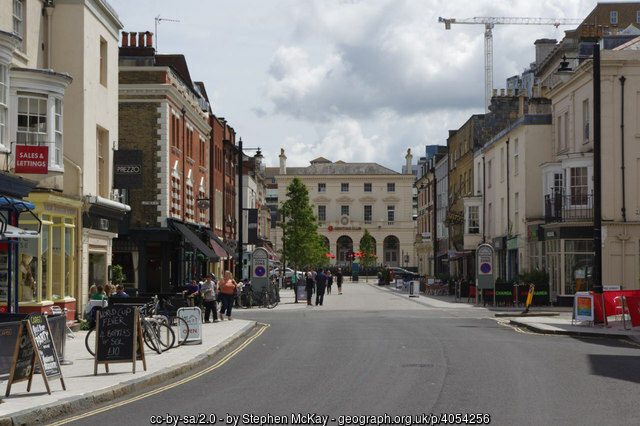
    Oxford Street, Southampton (license: See watermark)

    Nick would move in with his partner, and find a place not too far from Avenue road. We’d not really spend much time together, and our respective moves had left us quite far apart. That chapter would close for now. We’d both had over a year of fun and hedonism in the little house on Avenue road, but it now felt like we were rejoining civilization and being all grown-up, like.

    That August also brought a two-week holiday in Poland, which was utterly fantastic. I saw a lot of the country, swam in the Baltic, and camped in a tent for the first time in about 20 years. I liked Poland, against all my expectations, knowing nothing about it. Krakow is a beautiful city, like Prague but without the insane tourist numbers, and the mountains around Zakopane are breathtaking. They like their beer and food, too. I was startled to realise I’d been staying within a few miles of what used to be Auschwitz the entire time, but it’s just part of the history, and history is all over Silesia.

    Gubalowka, Zakopane.
    Zakopane, Tatra Mountains. By me.
    Wawel Castle, Krakow
    Wawel Castle, Krakow. By me.

    Work would give me a golden opportunity. They ran evening classes for Cisco System’s CCNA certification. This remains the single most useful knowledge I’ve acquired in my career. It’s golden, and it only cost me my time. Being able to do this was highly influential in informing my own attitudes to professional development. It was three hours every Tuesday, and was taught by a lovely bloke named Imran who worked in IT for the National Air Traffic Service (NATS). Instructing was his side gig. The knowledge continues to serve me to this day. If you work in IT you should take the CCNA. It’s unbelievable how handy it is.

    Solent had a pretty fast social life, and Brought a lot of new friends into my life. Andi worked in the office upstairs, and we became good friends over time. Through Andi I’d get to know his friend Jen, whip smart, very beautiful, slightly intimidating, and great fun – if you could keep up. Then there was Berenika, another lovely Polish girl who was absolutely on my wavelength, and an absolute blast. I always felt a bit guilty around Berenika, because I liked her so much. She could charm the dead, that girl. Tessa worked right next to Andi and started around the same time as me; she’s in virtually every photo I have from the nights out. You don’t realise how much you miss people until you think of these things. Everybody got on with Andi, he had that kind of character, and he would go on to do me a huge, huge favour much later on.

    I finally had something I could call a profession. I had come a long way. Maybe I could go a little further?

    Life comes at you fast, as the internet likes to say. In Autumn 2008, a position for a support analyst opened in the main computing office in Solent. In IT terms, this would put me behind the curtain. It would take me away from directly supporting users, which I liked a lot more than I’d ever admit, but it was necessary to learn more and start taking on more responsibility. I’d been in post about 18 months, I didn’t feel too bad about moving on from the business school, on the very shaky assumption this would go my way. I remember thinking I had an outside chance, but didn’t think I’d swing it. I knew everybody up there, maybe that would count for something?

    I applied, and to my surprise, got an interview. I recall being pretty stressed out about this, because I considered landing the job a bit of a stretch, but still definitely within reach. In hindsight, it really wasn’t a big deal, I just wasn’t familiar with doing well so quickly, after years of trundling through bumfuck go-nowhere jobs.

    Nick (another Nick, not my old housemate) would be on the interview panel. He was already technically my boss, but in this role I’d be a direct report. Also on the panel was Stephen, and John, who ran the whole show. I gave an okay account of myself, but very much kept my feet on the ground. The worst that could result would be staying in the business school, but I had a feeling I was tantalizingly close, and I remember It driving me a little mad.

    To my astounded delight, they offered me the job the next day. I was elated. It was an exciting position, and a good bump in pay. It might seem strange but I felt like after years of fucking about, I was finally doing something decent.

    I would lose my own office, and join the cramped but cheery computing office on the top floor of the library. I’d be an understudy to Neil (my de facto supervisor), and Nick would be in the corner diagonally across from me. James was the Mac specialist and was directly opposite. A team of techs would fill the rest of the floor. Veejay was the nearest to me, and I’d known him since he oriented me on my first day at SBS. My job was essentially image creation and application packaging for the configuration management infrastructure, which was looked after by Neil. It was a time of transition to Windows 7 (remember that?) which offered different methods and would have to all be learnt and tested. Neil would do most of this work during my first year, then it would be up to me for the full switch to Windows 10 and a new configuration management solution the following year.

    Before starting the new role I’d spend a week in Spain with my dad; the 2nd of that year, on top of yet another trip to Poland in Summer. I’d also go out to Poland again in December. I travelled so much those days, thanks to the liberal UK holiday allowance and increased means. It is something the US could definitely learn from.

    I’d also started journeying to Hertfordshire on the regular to see P, who by now was well established in his Pharma career. I’ve got many happy memories of evenings watching films in his flat, with the warm buzz after a few beers down the pub, then the subdued feeling at 3pm on a Sunday of having to get the train to London as the first leg of the journey home. It was a long 90 miles when you’re feeling a bit blue. I don’t know why, but I preferred to go to Herts rather than host him in Southampton. I put it down to a slight feeling neither of us really cared for the place that much. We had spent a lot of time there, after all. There was nothing new to be experienced.

  • LOST Is back, I have some feelings

    Netflix, in their absolute unquestionable wisdom, have bought LOST. This is the show that is now regarded as the ‘Golden Age of Television’ in some circles. It’s not, that title will forever be owned by The WIre, and I am sorry, I will not be taking notes. LOST was the defining show of network TV, in much the same way Climie Fisher were the defining band of the 1980s.

    So of course, I watched the fucking pilot, for the first time since the absolute crushing disappointment that was the original broadcast run of the show. LOST was a glorious mess, a one-trick pony the likes of which we will never see again, because you can only pull this shit once, and everybody sees how it is done. It killed Westworld, for a recent example. “This show feels a bit like LOST“, I remember thinking, shortly before it died early, before really doing, well, anything.

    Mystery boxes – a perennial theme for showrunner Damon Lindelof, who got so badly broken by LOST he ragequit Twitter because people had the audacity to suggest his handling of the show was, like, shit, have a very short shelf-life. You can’t keep doing it. It’s boring, and it is not a substitute for solid storytelling. They were spinning plates, and they knew it, and by Season three, the audience knew it, too. Sky TV’s promo posters for Season 3, and I remember them very well, used to say “answers are coming”. It was an admission that the show set itself up for failure and had no hope for a resolution. We wanted to believe that they “knew what they were doing”. They didn’t.

    Ironically, LOST had fucking spades of great stories. It remains one of the greatest character-driven shows ever made. On form, the show was magic, but the writers never nailed the big picture. I remember in Season 2 with ‘The Hatch’ and the endless exposition the uneasy feeling the audience was collectively having its pisser pulled.

    Now the zoomers have got hold of it, and are fully embracing it in their weird little fanatical way. I wonder if they too will feel that burn of disappointment as the show goes on. Much is made of the ending. It’s okay, it’s just the show goes stale long before the finale.

  • 45 pt. 2

    Eyes

    By March my vision had continued to deteriorate to the extent I was becoming quite afraid. I made an emergency appointment to try and figure out what the hell was going on. I got a visit with an ophthalmologist that just happened to be a retinal specialist. She is French, had only been in the country a few months, as luck would have it, she was absolutely brilliant.

    Generally speaking, nost of the senior female medical professionals seemed better listeners, and thus far I wasn’t convinced I was being heard. My wife describes this as a ‘specialist trap’, in other words if a doctor can’t diagnose a problem, they become indecisive and fail to advocate for the patient. You must see the right people. The right doctor at the right time makes all the difference. In the US system in particular, you must learn to stamp your feet. It’s very hard for me, as I am a classic British never-complain type, but when you’re really sick, that attitude can kill you.

    This particular specialist took complete ownership of everything, and the more difficult the case got, the more interested she was.

    I had some images taken of the eye, and she immediately identified inflammation of the nerve bundle behind the retina. This is generally known as posteriour uveitis, and it’s potentially very serious.

    I had to undertake a lot of tests, includng tuberculosis and syphilis,(symptomatically similar) which amused me (yes it came back negative, you shits).

    I ended up being prescribed an oral steroid (prednisone) in a shock dose, tapering off as time went on.

    Steroids do odd things, it felt to me like I was highly caffeinated; I couldn’t sleep, put on a load of weight (yay!) but avoided going crazy -Apparently some people don’t respond well to them.

    My vision stabilised, you wouldn’t call it good but at least it wasn’t getting worse. Uveitis is idiopathic in about half of the cases. In simple terms, it it not known what causes it. At this point it was purely hypothetical that my vision problems were linked to whatever was growing under my arm, immunology is complicated and requires highly specialised domain knowledge, there isn’t a magical test for it. The test is basically ruling out everything else.

    Tumour won’t wait

    The mass under my arm was no longer leaking, had fully re-accumulated, and was now starting to press on surrounding tissue, which caused pain. Around 1am on the 3rd of Aoril, I realised I could no longer sleep. Heat, painkillers and and ice-packs did nothing. I remember sitting on the bed in front of the wardrobe mirror thinking that I have to do something.

    My wife had a continuing concern that it might burst, which could be life-threatening. My plan was to go to the ER, perhaps they could drain it, or at least get me some pain relief.

    The emergency room reception wasn’t busy, a TV played one of house-hunting shows where a couple have an incredible budget. It was set in Fareham, just a few miles from my previous home, which made me laugh at least. I got triaged quickly. The feeling of the nurses – rarely hesitant to give an opinion – was that this thing needed to be out. No shit. A young doctor told me she couldn’t do anything invasive as if it was potentially malignant as that could be harmful. so, no drain. In the meantime she saw me wincing with pain and suggested an analgesic. I got a long lecture about opioids “You’ve seen the news, right?” And then they injected something with a long name into my IV

    It felt a bit like the drop off the lift-hill on a rollercoaster, I actually held on to the sides of the bed, I felt a kick of nausea, thought I might throw up, then it passed. I was now, to use the medical term, as high as fuck.

    The doctor got on the phone to the surgeon (I think it was 3am) and got it done – I would be operated on the next day. My bed was moved to a remote end of the ER and I entertained myself sending Beavis and Butthead gifs to my sister.

    Beavis_Butthead

    I don’t really know why, when you’re stoned everything is funny. It had to bag up my clothes and belongings and put on a gown.

    .

    Dark, dreamless sleep

    I got visited by the anaesthetist, who explained that I would be asleep through it all, and a reflexologist, as the surgeon was concerned my nerves were getting damaged by the tumour, but this was luckily not the case.

    My abiding memory of ‘serious hospital stuff’ is the flourescent lighting scrolling overhead as you are moved on a stretcher,that and the smell of alcohol swabs and the chirp of ringing telephones. The operating room actually resembles a hotel kitchen, lots of stainless steel, aluminium, and dark tiling. Only the huge overhead lights set it apart, and large pieces of equioment that go ‘beep’. I had to move laterally onto the OR bed and had my inflatable stockings switched on, which feel a bit like a python constricting around your shins. That’s all I remember

    Waking up from a general anaesthetic is abrupt, it sounds like people are shouting.You wake up with a start, It’s such a deep sleep. I wasn’t aware of any pain, but my armpit felt like it was completely gone, which was weird but also a relief. My treat was a cup of crushed ice. I hadn’t eaten in about 17hrs.

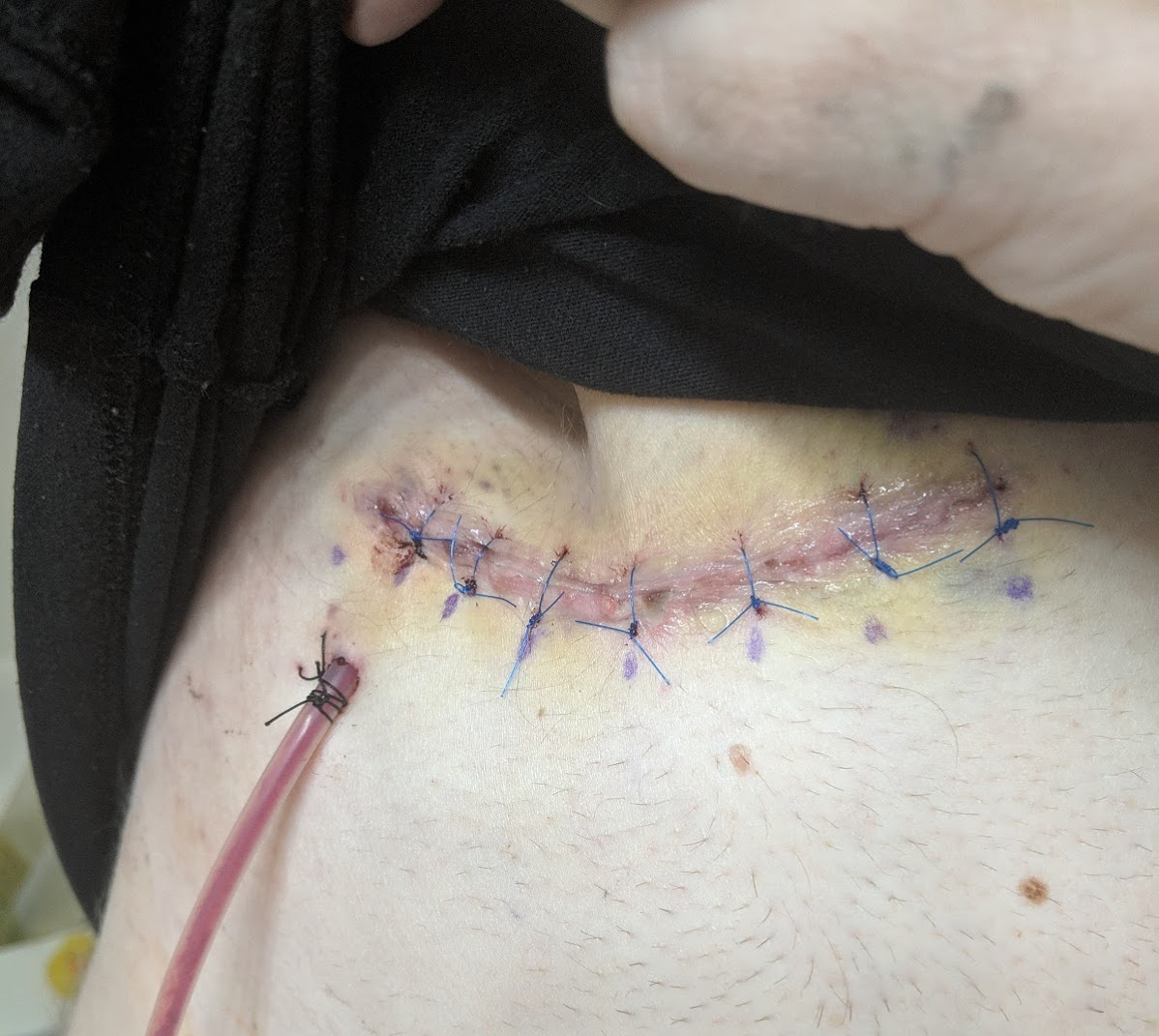
    I spent a night in the hospital in a very pleasant room, and stood up for the first time in hours. I had a drain fitted, which is a plastic line from the surgical wound terminating in a rubber bulb.

    surgiclvwound
    Wound and drain line

    This fucking thing would be the bane of my existence for a week. A fwwnurse ran in and told me if I needed to urinate it had to be into a plastic flask about the capacity of a litre. I filled that fucker to the brim, handed it to her and said “enjoy”. She didn’t even smile- heard it all before, I expect.

    The surgeon visited and instructed me to monitor the drain, as he did not want it in there any longer than necessary, as it’s an infection hazard. He also explained the surgery was a success apart from having to leave some tissue which had tied itself around a vein. This would cause almost 5months of discussion as nobody seemed to think anything should remain in there, given how fast the tumour developed, but that story will have to wait.

    At home, I had to learn to live with the drain, which was a great annoyance as the slightest pull on the tube was sharply painful. I had to sleep on my back (which I never do) so it was a tough few nights. On the very day I had just got used to it, I made the appointment to have it taken out.

    It would be many weeks, and several labs before the tumour’s classification was known. In the meantime my oncologist wanted to discuss options. At that time it was possibly some radiation therapy along with some chemo. Great.

    Black May

    I had so many appointments in May I lost count. I’d had my drain and stitches out, my oncologist informed me that the mass was classifed as a ‘metastatic melanoma of unknown primary’ in other words, skin cancer, but no skin lesion would ever be found. This supposedly true in 10% of cases. I had the feeling the onvologist was not that convinced, but genetic markers gave him treatment options. I would be put on immunotherapy, which had the reputation for miraculous results.

    I would require immunotherapy every three weeks for a year. I watched an educational video about chemo, and I mostly learnt to be grateful I wasn’t having chemo. The treatment building is a squat, brutalist structure near the mall. It struck me that nearly all of the people there looked very worse for wear. I asked the nurse if they looked like me when they walked in, but I don’t think she saw the funny side. </p

    To be continued

  • Death and all his friends

    February 16th, 2005

    I’d got the call I was waiting for, from my older sister. “You’d better come”. It was time. My mum had been fighting terminal cancer since the previous August, over the new year we were waiting for the other shoe to drop. She’d become increasingly frail and had lost a shocking amount of weight. A couple of days earlier – Valentine’s Day, just to twist the knife a little – she’d had a precipitous decline. I didn’t fully understand the biological mechanism, but her failing liver being slowly consumed by cancer (which would go on to kill her) meant she was slowly poisoning herself, most evident of which was the loss of mental faculties. I had been warned she was in a pretty bad state, neurologically.

    I had understood some of this when I arrived in Southwark, but not the extent of it. Leaving the underground at London Bridge and walking to my parent’s flat, a journey I had taken so many times in happier days, I did not know what to expect.

    My sister opened the door. As I walked into the entryway I caught sight of my mum sitting upright in bed, apparently trying to get on her feet.

    Is that my boy?

    The words were feeble and quiet, but It sounded like an anvil dropping to my ears. She was obviously in very poor shape but wanted to get out of bed to meet me, to put on a bit of a show, to let me know she was alright. She wasn’t alright. Those four words were the last coherent thing I would hear from her. For the rest of the day she just looked into the distance, making no sound.

    want to trip inside your head
    Spend the day there
    To hear the things you haven’t said
    And see what you might see
    I want to hear you when you call
    Do you feel anything at all?
    I want to see your thoughts take shape and walk right out

    There was no life in her eyes. This hurt most of all. I remember looking deeply into them to see If I could see any flicker, any remnant of my mum in there (that U2 lyric would be swimming around my head for days. I still cannot listen to that song without thinking of the lonely evening train up to London) I was struck by the thought that his person – my mother – was no longer there; that all she was and ever had been had been taken from me, leaving just this corporeal thing, an empty shell. It sounds dramatic, but I had about 15 minutes alone with her and the memory is still absolutely devastating to me. She was so still and quiet. The slow destruction of a person -a parent – is a terrible thing to witness. In time I recognised this was worse than anything that followed. I wanted to scream, I was so upset, so confused, so absolutely wounded, but I kept it all in, because i was desperate to reach her. For me, this was worse than death; someone stripped of their faculties and their dignity, helpless, frail, and dying. What this disease can take of a person made me loathe it. This woman carried me into the world, and she had been so greatly diminished (she was tiny, tiny by the end) I still wince at the memory.

    She would hang on for another 9 days, before passing away with us all there around 6.30pm on February 25th, 2 days after her 62nd birthday. I think my dad thought she’d held on for it, but I’m not sure if she had sufficient awareness to know either way. I almost had a nervous breakdown during that period, it came out as a bit of a tantrum in Tesco at Surrey Quays, but I was sleep deprived, under severe stress, and starting to crack. I had to get her a birthday card, and it sort of lit the fuse. No, I was not alright. I don’t know if I’m alright now.

    I swore at the time that if anything like cancer happened to me I would not let it go that far, that I would not want anyone to see me like that. I have no idea what that might have entailed. Maybe I would jump off Beachy Head, or go and walk into the sea somewhere, let the waves claim me. I was, of course, completely full of shit, because I would get to find out. Life, as the saying goes, is a bitch. Also Irony when I think about it, thanks Alannis.

    Who said God had no sense of humour?

    Fate would take a run at me. I would get get the disease, not the same kind and mercifully not as severe, although in fact very dangerous. Melanoma is a big, big killer, and I really won the lottery in getting to remission. I may be half-blind, but in all likelihood it’s not going to kill me. Yes I’m tempting fate, but fuck fate.

    Bad days are better than no days

    There’s a sticker that says this at the reception desk at the infusion centre. It made me laugh at the time, because it’s a bit Oprah, but it’s definitely true. it’s easy to retreat into solipsism and self-pity, and I have definitely had those moments (“why me?” Why anyone, dickhead…) but you have to just keep going and be there. It’s a different story when you have a family. You learn to eat some shit and smile, then eat some more. Every day is a small victory. I know that if the worst were to happen to me, my family would be there to the end, and they would deal with everything that followed, because when the time comes, people find it in themselves. Every three weeks I sit down and get 200mg of immunotherapy drugs. The people there always impress me. Some are very much in the trenches with their illness, but they have such incredible spirit. It’s not at all what you might imagine a chemo treatment centre to be. I mean, it’s not cartwheels and fireworks – it’s still a godawful situation for all concerned, for fuck’s sake, but everyone just grins and bears it. For obvious reasons, I’ve a bad association with hospitals – the smell of disinfectant, rumbling air vents, and prospect of death – and I’ve come to realise it’s not like that at all.

    This helped me understand what happened with my mum that day, finding that last shred of strength and dignity to try and show me that she’s okay; that through all she was enduring she would stand tall for her son.

    I recently started to dream about her pretty regularly. The illusion of dreams is that you don’t really question context – “What am I doing here? Why can I fly?” I never question that she shouldn’t be there – although I had those dreams in the past. It’s just normal, she’s alive and we’re doing mundane things.

    The month before she died, I think it was the first week of January, she had a distinct rebound, a period of high function I would learn is not unusual in the course of terminal illness. We had a nice weekend together, we chatted and watched a film (2004’s Collateral) and I thought for a moment that maybe she’s getting better. But it was not to be. Anyway, I mention because that’s how she is in my dreams. Just normal.

    I don’t question it too deeply, but it’s a pretty comforting thing for my brain to do. Her headstone in a quiet hilltop Andalusian cemetary reads “Until we meet again”. I don’t know if that will happen. I don’t know if I believe such a thing is possible, but we’ll see I suppose. Hopefully later rather than sooner.

    LON_0023_1024
    MCT, 23/02/43 – 25/02/05

  • Tim Bisley Is Wrong About Babylon 5

    Spaced S02E02 is a playful tale about the pitfalls of fandom. I have to say up front that I am at great risk of doing exactly what Bilbo Bagshot (Bill Bailey) cautions against:

    “…Defending the genre with terminal intensity”

    Yeah yeah, I know. In the episode Tim (Simon Pegg) gets himself sacked by Bilbo for bullying a child over The Phantom Menace (seriously, watch Spaced, it’s brilliant), followed by the amusing efforts of a remorseful Bilbo to get Tim to return by means of getting himself fired from his new job. Tim achieves this by informing his boss (Martin Treneman) that “Babylon 5 is a big pile of shit”, and getting dismissed on the spot.

    Tim decides on direct action to abandon Silent Reading

    I like Spaced so much that this opinion seeped into my conventional wisdom, so it was a pleasant surprise to discover that B5 really isn’t shite at all. I’m not a devout Sci Fi fan, I don’t know the genre especially well, but I do enjoy a bit of TV and Babylon 5’s great strength is that it avoids a lot of modern telly’s problems, namely the writer’s room getting lost (not an accidental word choice) in the whiteboard. Too many shows have a brilliant premise, great characters, and just don’t land it (LOST), characters that lose any consistency (Walking Dead) start plot lines they can’t hope to finish (LOST) or wander out into the dark, talking to themselves, never to be seen again (Westworld). B5 for its minor flaws avoids this. I think much of this is down to J. Michael Straczynski, who had a story to tell, and apparently doesn’t compromise in telling it.

    Babylon 5 is unashamedly long-form. It isn’t perfect (S4 is fantastic but has very,very odd pacing for reasons I understand but won’t go into here) and I write this having started S5 which is polished but feels a bit redundant (again, there are known reasons why). The fans are tough on S5, but I am enjoying it and sticking with it. A little bit like Blake’s Seven, you have to get past the production glitter (It looks pretty naff early on in S1) and seemingly hokey characters (“Who the fuck is this Napoleonic looking guy with the absurd hair?”) to reveal some real depth, and great, even brilliant storytelling. I was surprised how much I liked it.

    Spaced was made just at the beginning of the dot-com boom. Internet ‘culture’, was not yet ubiquitous, the show barely mentioning it. In 1998-2001 social media didn’t exist and fandom as we now define it hadn’t really taken off; IRC, chat, and forums were still king but it was all still very niche, however writers Simon Pegg and Jessica Hynes were well aware of the ferocity that the subcultures were capable of. I wonder what they’d make of it all now, because now it’s fucking awful.

  • Dream Time

    The North of England.

    It’s a Sunday. My trip is over, and it’s time for me to go. There is a familiar feeling in the pit of my stomach – some call this butterflies – and I can feel the minutes tumbling away, as a veteran procrastinator can.

    Somehow, It’s now the afternoon. I have of course been putting the return journey off. I am all too aware of the clock turning past 1pm. I’ve a long journey ahead of me, around six hours. I look at my mum in the kitchen, her soft smile invites me to stay, at least that’s what I want it to mean. If I leave now I’ll be home around 7pm. Plenty of time. And yet…

    The sky dims ever so slightly, it’s later, I think around 5pm. I can still get home in time for bed. I’ll have to drive in the dark, but it’s not really a problem, but then I realise I have to retrieve my car. I know it’s parked further away, for whatever reason I couldn’t park closer to home. Where did I put it? I can picture the street. It’s somewhere in Pimlico, in London. I need to go and find it, so I set out, the journey and the confusion about the whereabouts of my car and the anxiety of the long drive ahead race around in my head. Do I even know the way home? I’ve done it so many times, but suddenly I realize I have no idea how to navigate home.

    London is about 300 miles from where I supposedly am. I don’t question the spatial impossibility. I don’t question the fact my mum’s alive. These are the considerations of daytime; things just are in this dream world, and my higher functions don’t get a vote.

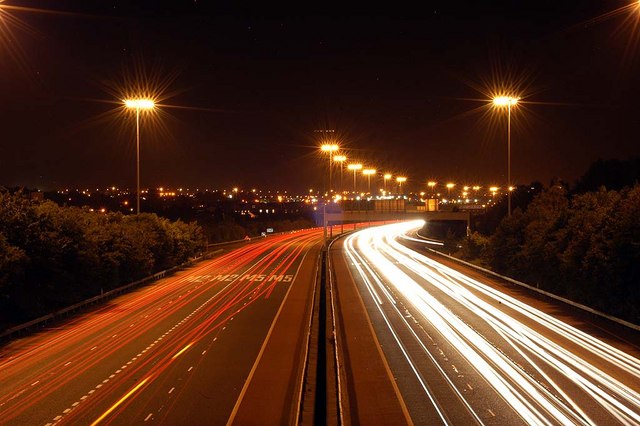
    Wilson Adams / M2 Motorway at Night https://creativecommons.org/licenses/by-sa/2.0/

    If I leave now, I can just get home in time for work tomorrow morning. Maybe I’ll drive through the night. I just need to find the car. The dream – of course – becomes all about finding the car.

    In the dream the journey never actually starts. Other times it starts, but I never get to where I’m supposed to go (I remember being stuck at a motorway service station, an actual nightmare of dour buildings and expensive shite sandwiches) It is the state of needing to be somewhere that prevails. The missing car is funny; this is a common theme, in another dream it was in a parking garage so tall and labyrinthine It was like a Terry Gilliam creation. There is always some obstacle to making progress, like Clockwise with John Cleese but deeply, deeply filled with anxiety. It’s closer to Mark Corrigan, honestly.

    I’ve never felt these problems that much in real life, but I have always had butterflies about travel, a restless urge to get going. Friends and family have said that when I have somewhere to be, I get antsy.

    London: somewhere on the underground.

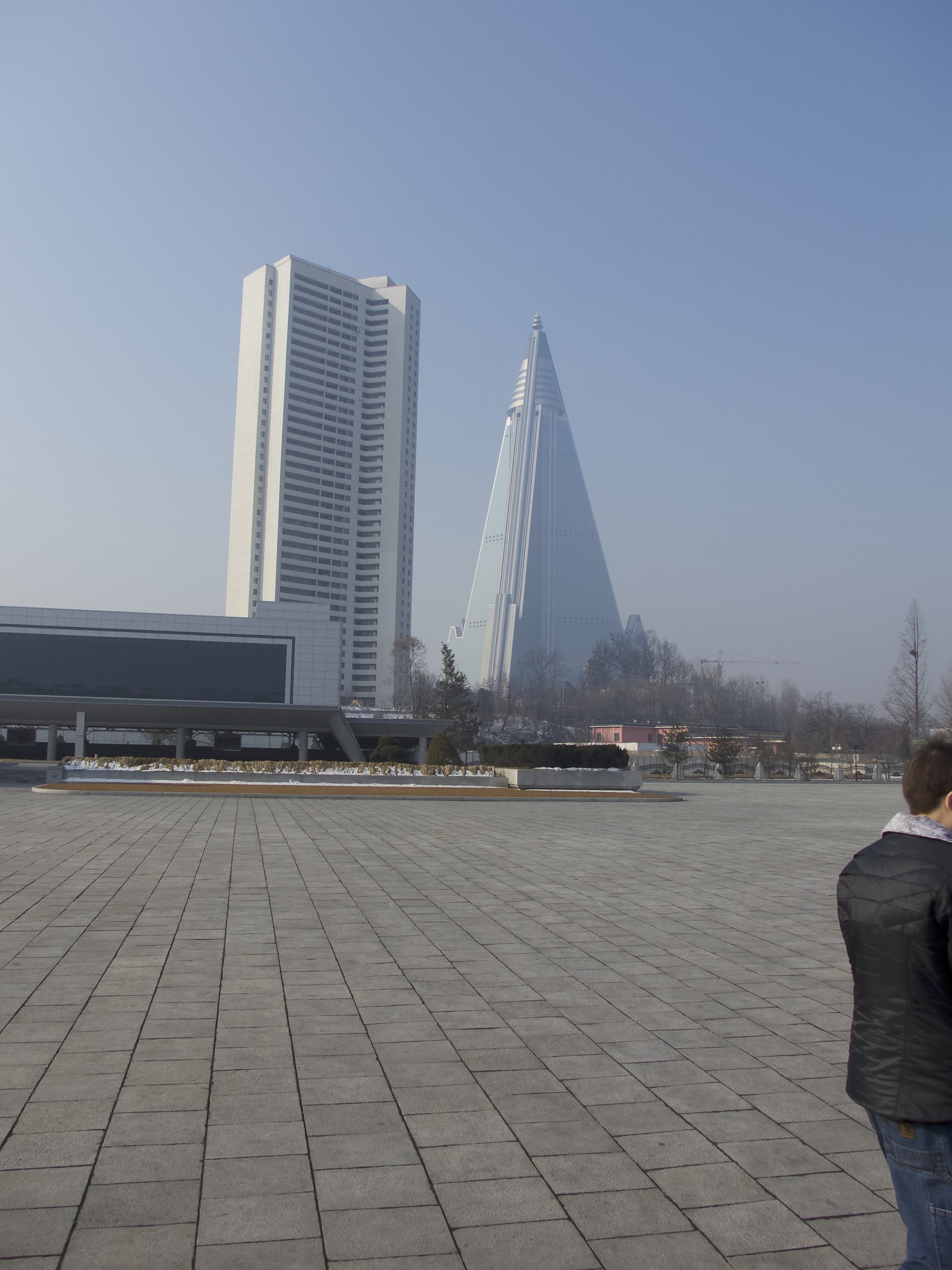
    I have to get to Waterloo railway station,I know I’ve got to change trains, this London Underground station is vast, with seemingly endless stairs and walkways. There’s people everyhwere. I need to get a through ticket to Southampton, too (why don’t I have one already?) I go to the ticket office – which is impossibly, ridiculously far away – but it’s all confusion and queues. I am certain that if I join a queue I’ll never make the train I need. I decide to go upstairs and outside. The outside of the station feels familiar but I don’t recognise it at all, it’s open like a city square, spacious and absolutely not anywhere I know. It’s like a version of those huge open spaces you see in places like Pyongyang (which I have also dreamed of…another story!)

    By Yoni Rubin, CC BY 3.0, https://commons.wikimedia.org/w/index.php?curid=58951668

    I am again not sure where I’m supposed to be going. I did know, now it has left me, and it’s just the feeling of whirling anxiety and disconnection. I have to be somewhere. I’ll never make my connection, I don’t even know what time it is, or where It is going. I’ve tried to catch connecting trains at stations so vast it’s comical when I think about it. The overground train of my dreams in London ran on on tracks so vast they were like a huge metal belt over the city, 10 lines wide and undulating like an old wooden rollercoaster. You could also walk on them, if you wanted to. I (as usual) never really know how these end, but I don’t get there. Sometimes it’s a bus, but the stories the same – I am racing a clock, and sometimes the specifics of time don’t matter, I just know I’m running out of it.

    Spain

    It’s the last evening at my dad’s place in Spain. But it’s not anywhere I really know, it’s a strange little world I dreamt up. There’s a large hillside behind it which is actually from a childhood holiday In Scotland (try harder, brain) and a beach that I’m pretty certain is Dubai, and the dream shifts seamlessly to these places when I look at or go to the location. On the hill? Back on the isle of Skye. On the beach? This is Dubai. Again, I do not question it. It is my dad’s universe and I’m floating around in it. But what’s this you say? Yes. Time is running out. Of course it is. Don’t enjoy the scenery too much because you have somewhere to be, young man.

    I have to get to the airport. I habitually (in reality) like to leave a couple of hours in hand for a flight. I haven’t really packed anything, so I tell myself to get on with it. Imperceptibly, moments pass and I suddenly realise time is now very tight. am in the car with my dad, I don’t think we’re going to make it. We cannot possibly make it. What flight is it anyway? I don’t remember. I’ll find out when we get there. I get to the airport and realise I didn’t even book a flight, so I set about organising one, as if it is like taking a train. The lines for the counters are so massive that I wonder if I will ever leave that airport. Sometimes i get on the plane, and the dream breaks completely; we have to drive down the road because there’s a problem with the runway. That’s right – the plane drives along the road, like a bus. This has happened enough times I don’t even question it.

    University

    I’m in a hall of residence (a dorm, in American parlance), my room feels familiar, but I do not know this place. It is an amalgamation of many places I have known, but again large and complex in the way only an imaginary thing can be. I can hear my neighbours running around. They’re all aged about 20, and apparently, so am I. I remember that I haven’t been going to class for weeks on end, and at some point somebody is going to realise. I’ve got a mathematics class this morning. I decide not to go. I don’t know if I’ve ever been, It’s impossible for me to pass the year now, this must be catching up with me. What am I going to do?

    I walk out into the corridor and chat with friends. I am extremely anxious about explaining all of this, when the time comes, and come it will. I’m sure of it, and it is the only thing I think of as I contemplate the magnolia walls and beige carpet. There is a smell of disinfectant and stale beer coming from the kitchen, which doubles as a common room. I’ve never had a recurring dream that actually goes anywhere near a classroom, it is always a version of this place, but the place is different every time, but it has the same look and feel.

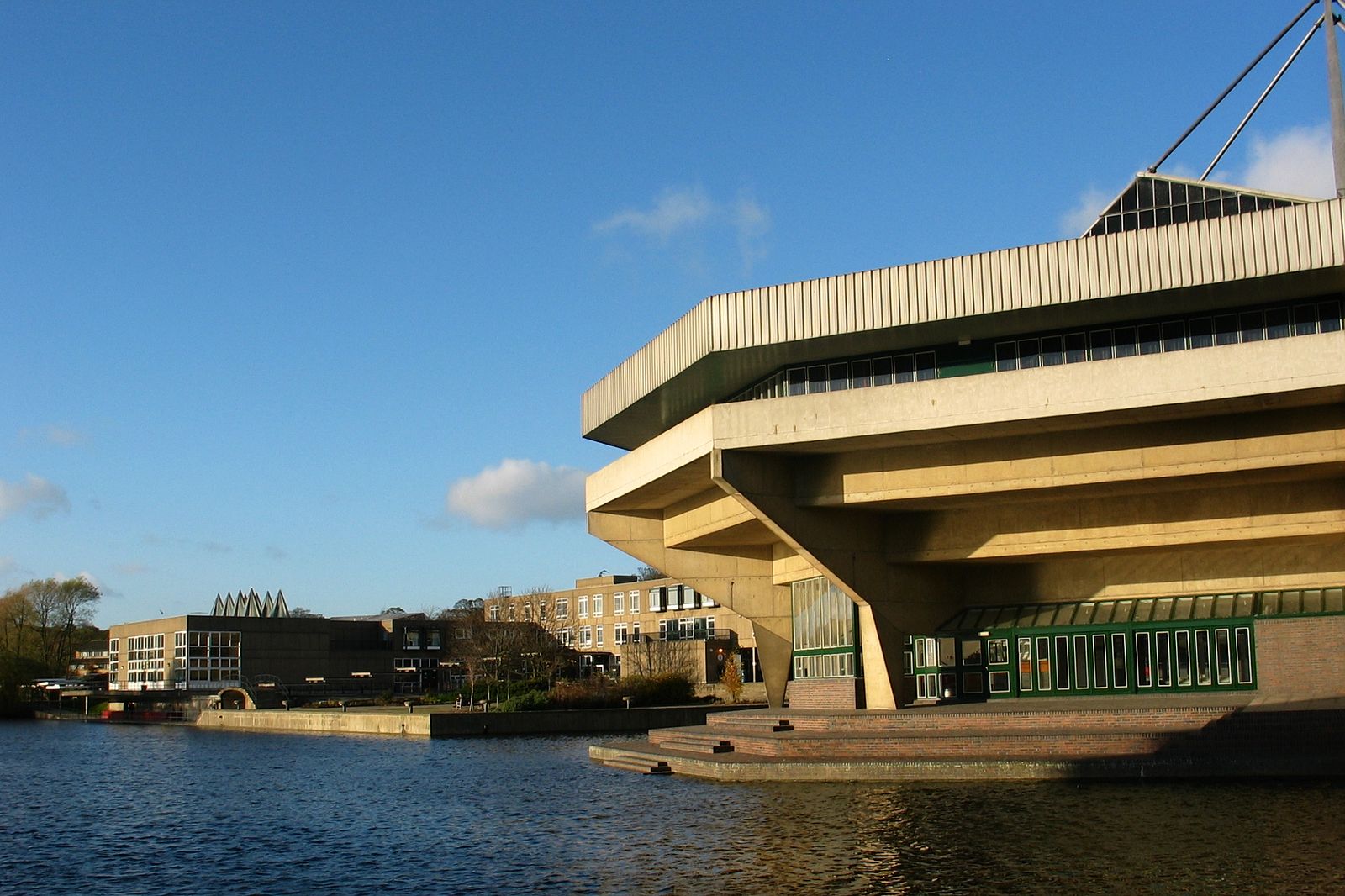
    Sometimes it’s York university campus (of the 90s), or a version of it. Artificial lakes, paved walkways, 60s concrete buildings everywhere.

    Arian Kriesch, CC BY-SA 3.0 http://creativecommons.org/licenses/by-sa/3.0/, via Wikimedia Commons

    It’s huge though, far bigger than the real thing (see a trend?) and seems to go on forever, and I never get beyond walking around the little paths going from building to building. The dream always ends in this transient situation.

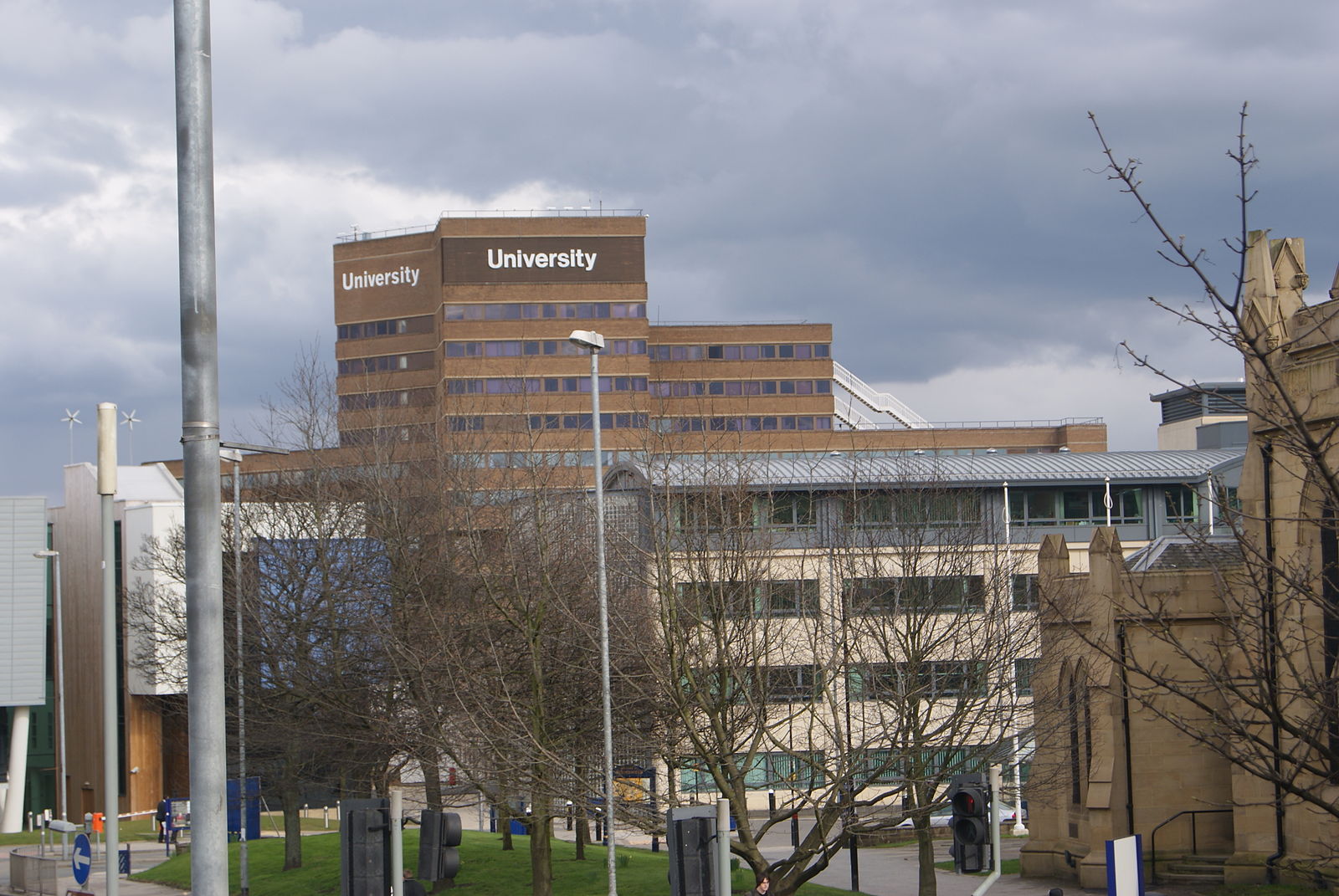
    Sometimes it’s an obvious replica of the University of Huddersfield central services building (which I knew), that held accommodation, except the elevator is gigantic, like a living room, and as you go downstairs it becomes a rural hotel, but outside on top of the building are little rotundas with more accomodation in them – a total figment of my imagination, almost like science fiction but rooted in a sort of brutalist aesthetic. The places all start real enough but then my head doesn’t keep it all together and it becomes disconnected and ridiculous, but there is always the pressure, and the worry, about something that is like dreaming of having no clothes on at work or something daft like that. It’s this panicked feeling of missing work and classes and being found out.

    Mtaylor848, CC BY-SA 3.0 https://creativecommons.org/licenses/by-sa/3.0, via Wikimedia Commons

    . So what does it all mean? Well it’s pretty obvious, innit. It’s anxiety. These dreams come along like buses as soon as I have something on my mind. Just before I moved to America, I would have the travel dreams daily. Whenever I get busy or stressed they start up, and they’re a good indicator of that.

    I also dream of the past a lot. Friends, exes, and loved ones. Sometimes it’s about being back in a living situation I’ve long since moved on from, and weirdly they’re almost always in England. I just don’t dream of America, and I’ve been here a decade, so this is very much my head ruminating on the past, for whatever reason. It’s a life I let go of. Or did I?

  • The Tool As The Work

    I’ve been using Linux in some capacity since tinkering with it in a lab at my old job in 2005. That’s not a long time by enthusiast standards, but it’s not nothing, either. I saw this post on Reddit and the sentiment stuck in my throat a little bit.

    I’m a bit of a distrohopper – not on my main PC, but I have the “luxury” of having literally dozens of older boxes laying around my house and I’ve tinkered with a lot of distros since 2009, when I went full Linux.
    For the past few years I’ve been thinking what changed in Slackware to turn it from my favorite distro once into the one that is immensely frustrating for me to use – and I don’t think anything has changed about Slackware itself.
    The concept of “slack” in “Slackware” stems from you not having to install anything – it has you covered with all that software it provides. But am I wrong or is that a really “mid-2000s” thing to want? As Internet speeds grew, it became quicker and easier to just get everything you want from repos – not stuff preselected by the distro either, the stuff YOU prefer.
    And you can use Slackware like that – build up from base system, install package by package with Slackbuilds, tracking dependencies yourself. I know, because I have built my OS like that in the past. And the results can be great! But Slackware fights you on that. It recommends you install a whole lot of useless crap, it doesn’t provide any tools to get rid of unneeded dependencies automatically when you delete something you no longer need (sbopkg does, but slackpkg doesn’t). It’s a good learning experience, but it’s frustrating and hard to do – especially compared to most modern distros, where you can get a minimal system with the selection of packages of your choosing in minutes.
    I think Slackware may still have it’s place somewhere with limited internet speed/access (similar to endlessOS, perhaps). Personally, I just can’t really justify using it any more – between either accepting a bloated and arbitrary default package selection, going through the long and frustrating process of deselecting individual packages during installation or building from base system, which feels like working against the flow of what Slackware wants to be.

    I started out with Lindows (now Linspire), which was a highly beginner-friendly distro of the time, intended to tempt the Windows XP refugee. We couldn’t get it to work at first (lol). Went to Debian after a battle with the graphics card in the aging IBM desktop I was using, discovered Ubuntu (Swahili for ‘Can’t Install Debian’ as The Register quipped) which was manifestly an easier experience (Wifi worked out of the box, a miracle at the time. You kids have no idea how good you have it) and realized I wanted to learn more.

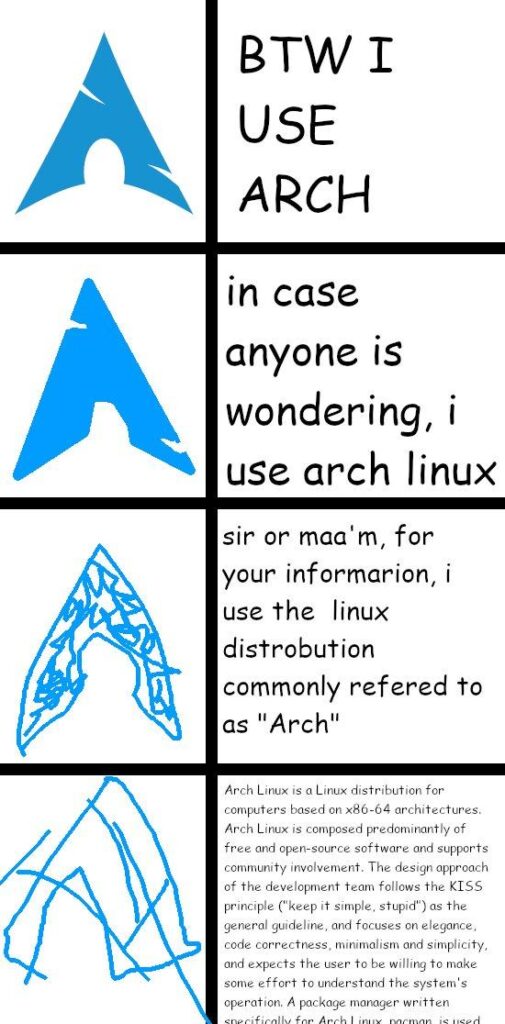
    So I tried out Arch Linux. Arch, I will say up front is a fantastic distro, probably one of the best around (still). It gives you nothing but a boot disk and excellent documentation, and following the install guide to the letter gets you a working linux system, and the means to do what you want thereafter. It’s an incredible learning tool (what it teaches in terms of basics is a foundation you can use everywhere) and has the distinction of now being a meme.

    There’s nothing difficult about Arch; if you can follow instructions you can install it. The community is mysteriously up its own arse. They can be proud of their distribution, if not themselves.

    I was fortunate enough to find a career involving Linux. System Administration has a way of really getting to the root of just how simultaneously difficult and wonderful open source can be, but also – I have to say – how irrelevant desktop Linux is to it all. I tended to try and follow the open source way, minimizing proprietary software and dog-fooding a linux desktop just to force myself to always be learning something.

    For the most part, I loved it, and still do. If all you really need is a terminal and a web browser (a mail client at a push…) you can’t beat desktop Linux. It’s reliable, flexible, can be left alone and just stays out of the way. For the most part. Those last two represent one of the challenges of ‘enthusiast’ distros.

    That is to say, if you’re spending more time trying to get your distro up and running and maintaining it than actually using it to do a job of work, it will start to get on your nerves sooner rather than later. As with relationships and cars, high maintenance becomes tedious and annoying.

    I ran Arch for a little while. An update broke it (it happens; the forum will usually chide you for not reading the news items on the front page which say something like “Because we can, this latest update will cause breakage because we really like yelling at people on the forum for not reading this”)

    Arch’s news items often contain critical notes about frangible package updates.

    It wasn’t broken badly, but I did not have all day to sort it out, so off it fucked. I replaced it with Slackware, which is the longest running Linux distribution still in development, and the subject of the Reddit post above.

    Where Arch gives you the building blocks and a framework for building out a system for whatever purpose you want, Slackware provides a working system with software as the standard install. You can get cracking wherever you are, internet connection or not. There is a package manager, but uniquely in Linux distros it does not handle dependency resolution. This is not as crazy as it sounds, as the base system has most of what you need to work, and most of what you need to compile packages from the extensive Slackbuilds project (which uses the same system to build packages from source that the distro does). You can say Slackware is not just a distro, but a whole way of thinking about a distro. It is both cutting edge (if you run the current branch or are close in time to a stable release) and conservative in that things should be simple, and they should work. You’ll find plenty of ostensibly old software in Slackware, but if it works (and has no vulnerabilities) it gets included. It is utterly reliable and stable, in my experience.

    I ran 14.2 on my work desktop for ages, until the day my desktop hardware got refreshed and meant a switch to something newer (the Xorg stack was just too old for the GPU and I was not going to take the time trying to sort that out) and I could not get the migration to the Current branch to work without a full reinstall. I needed to get working, and that was that. The fact that basic internet these days allows one to ‘get anything they need’ (which is actually how you build Arch Linux up from base) doesn’t mean Slackware’s approach is redundant, because choice is still going to be constrained by your distro’s package manager or your ability to build it yourself, which isn’t particularly easy if you’re unfamiliar.

    Good luck maintaining your system when it’s composed of a mix of official packages and source-compiled specials (ask me how I know…) Slackware’s philosophy of adopting the Slackbuild system (a simple shell script) to create a standard package is a really nice approach, and you appreciate the beauty of it over time. If you take a bit of effort to organize things it’s not hard to stay on top of it all.

    I ran Ubuntu 18.04 LTS for a while, and it worked really well. It was simple, had everything I needed, supported things like Zoom which became essential to my job, and ran without fail for a long time, I was able to integrate it with some other proprietary tools like our endpoint protection and backup agent which made life easier, if taking me a bit from ‘the way’. I do not love Canonical’s drift into increasingly restrictive proprietary practices, like fencing off updates to a subscription model after five years from LTS epoch. That can be a pretty short period if you’re mid or late cycle.

    The point is if you want to tinker with distros that’s a pursuit in and of itself, but it’s fuck all to do with productivity. I have to emphasise It doesn’t have to be, especially if that makes you happy. Slackware is great for just getting to work and being exceptionally easy to maintain once you know its ways. It also has the loveliest people behind its development and community.

    I built KISS Linux on a laptop recently just as an exercise in faffing about, and honestly going back to basics (though getting it working was anything but basic) was really interesting in reminding me what I enjoy about Linux and open source, but also how far Linux has come in terms of bells and whistles. You lose a lot in a simple WM environment. Do you need it? No. Is it nice to have? Absolutely. I really got sold on i3 and its Wayland derivative Sway as a working environment, it’s really efficient. Would I attempt it as a productivity platform? Not now. Too many compromises I’m not patient enough for at this time, but it’s good to go back to basics and I have a play on the laptop when the mood takes me.

    Bloat is a common complaint of much in computing, and open source. But you can’t escape it really. Even KISS has to use the Linux Kernel, which is an absolute nightmare of LOC chonk. It also amused me that Dylan Araps (author of KISS Linux) made Flatpak available as an optional personal package, Flatpak being the absolute total fucking antithesis of keeping things simple, But it works, and users like what it provides (I even built it on Slackware as I wanted things like Spotify and Plex Desktop because I’m a tart. Sorry, Pat!)

    Don’t worry about the thing, use the thing. That’s all that matters.